
Insights & News
Insights
Semiconductor apprenticeship standards are often published in hours.
The Urban Institute's March 2025 Semiconductor Processing Technician National Occupational Framework recommends 2,700 to 4,000 hours of on-the-job learning for a time-based or hybrid apprenticeship.
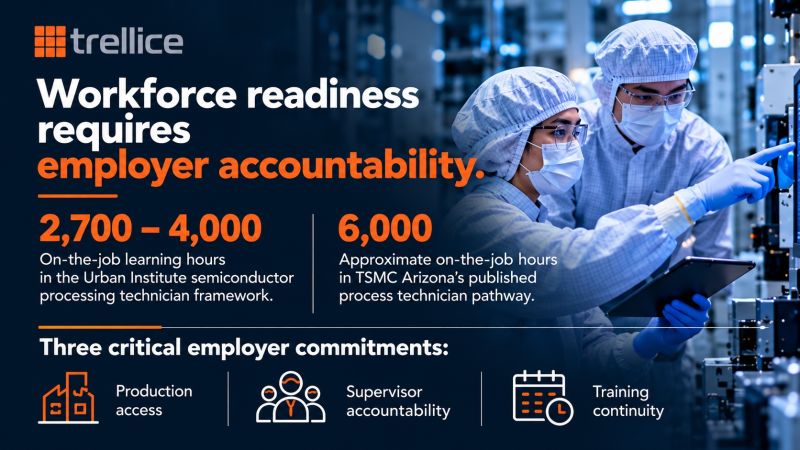
Registered apprenticeships also include related technical instruction. Federal guidance recommends at least 144 hours per apprenticeship year, although program requirements can differ. TSMC Arizona's published apprenticeship pathways illustrate how demanding these programs can become. Its equipment technician pathway includes approximately 4,000 on-the-job hours across two stages. Its process technician pathway describes approximately 6,000 hours across two stages. These are substantial commitments. And they raise a question that workforce proposals do not always answer. Can the person being recruited realistically complete the hours under the employer's operating schedule? Depending on the employer and role, semiconductor technicians may work nights, weekends, extended shifts or rotating schedules. Not every apprenticeship follows the same roster. But when required training experience depends on access to a live production environment, the operating schedule becomes part of the workforce design. Someone may have the technical aptitude. They may pass every assessment. They may be motivated to enter the industry. And still be unable to participate because the schedule conflicts with childcare, transportation or another job. That is not necessarily a skills problem. It is a program-design problem. Three questions should be answered before recruitment begins. 1. What schedule will apprentices actually work? - Not simply the number of hours. The shifts, rotations, notice periods and flexibility available. 2. Who is responsible for providing production access? - Which employer supervisor releases an apprentice for required training? - What happens when production priorities conflict with the training schedule? - Who bears the cost when scheduled training is cancelled? 3. What support is required for participants to complete the pathway? - Transportation outside conventional commuting hours. - Childcare that accommodates nonstandard schedules. - These requirements must be addressed before recruitment, not after attrition begins. Training hours, production access and workforce availability have to be designed together. A competency can be introduced in a classroom. Proficiency in an operating fab requires supervised experience. And someone has to be accountable for making that experience available.
Media contact
Trellice
Media Relations
info@trellice.com